
Global Markets Slide As US Tariff Uncertainty Shakes Investors
Introduction
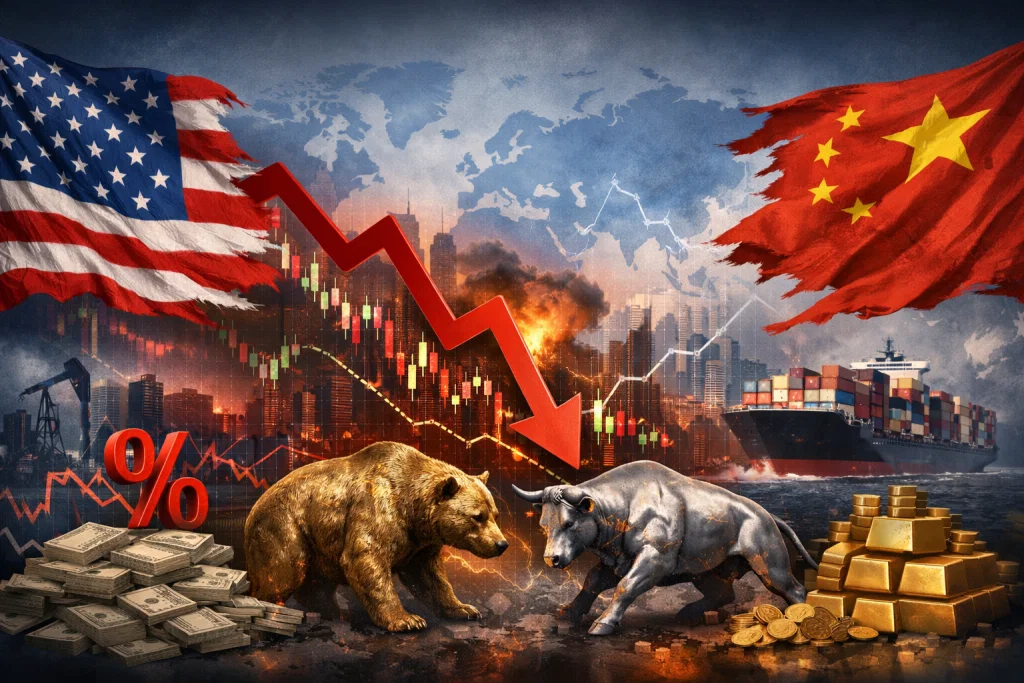
Global financial markets opened the week under pressure as investors reacted to sudden policy uncertainty surrounding United States tariffs, sending Wall Street futures lower, weakening the dollar, and boosting safe haven assets. The developments come at a sensitive time for global investors already navigating mixed economic signals, geopolitical risks, and heightened expectations around major corporate earnings. Analysts say the episode illustrates how quickly policy shifts can ripple through currency markets, equities, commodities, and investor sentiment worldwide.
Market Reaction To Tariff Confusion
The immediate trigger for the market reaction was renewed uncertainty about United States trade policy following a legal and political sequence involving tariffs. A recent court decision struck down a large portion of previously imposed tariffs, after which the administration announced a new temporary tariff of 10 percent on imports from all countries and then raised it to 15 percent, a move that reportedly surprised even some officials.
Financial strategists noted that unpredictability in trade policy tends to weigh heavily on investor confidence. One currency strategist explained that uncertainty is rarely positive for markets and warned that repeated cycles of tariff announcements and reversals could create a destabilizing pattern.
Investors remain unsure when the new tariffs might take effect, what exemptions could apply, and whether all countries will face the full rate. Some nations previously had lower rates while others faced higher ones, making the new framework unclear and difficult for companies to plan around.
Wall Street Futures And Global Stocks Decline
The uncertainty quickly spilled into equity markets. Futures tied to major US stock indexes fell before the opening bell, with contracts linked to the S and P 500 dropping about 0.8 percent and Nasdaq futures sliding around 1 percent.
European markets followed suit, with futures tied to major regional indexes such as the Euro Stoxx 50 and Germany DAX both declining roughly half a percent, while London FTSE futures slipped slightly.
Asian markets showed a mixed performance. A broad regional index excluding Japan rose modestly, suggesting some investors saw potential benefits if tariff rates ultimately fall compared to previous levels. South Korea and Taiwan markets even hit record highs recently, buoyed by expectations that effective US tariff levels might be lower in the short term.
Japan stock market was closed for a holiday, but futures indicated a mild decline, highlighting cautious sentiment across the region.
Dollar Weakens As Confidence Shifts
Currency markets reflected growing doubts about US assets. The dollar dropped against several major currencies including the Japanese yen euro and Swiss franc as traders speculated that chaotic tariff policy could reduce international confidence in American investments.
Such moves illustrate how quickly exchange rates can react to political developments. Currency traders often treat policy stability as a key indicator of economic reliability. When policy signals appear inconsistent investors may shift capital toward perceived safer currencies or regions.
The dollar slide also affected digital assets with bitcoin falling more than four percent during the same period indicating broader risk aversion among traders.
Commodities Reflect Risk Aversion
Commodity markets also reacted sharply. Gold prices rose as investors sought traditional safe haven assets during periods of uncertainty climbing more than one percent. Silver saw an even stronger surge extending gains after a sharp rise late last week.
Oil prices moved in the opposite direction declining modestly. The drop came partly as traders anticipated another round of talks between the United States and Iran. Market participants have been monitoring the negotiations closely because tensions or military action in the region could disrupt global oil supply.
The combination of rising precious metals and falling oil prices reflects a typical pattern during periods of uncertainty investors move into assets perceived as stable while reducing exposure to risk sensitive commodities.
Treasury Markets And Interest Rate Expectations
Bond markets were also affected by the shifting policy outlook. Analysts estimated that changes tied to tariff policies could force the US government to repay around 170 billion dollars in revenue, potentially widening the fiscal deficit by roughly half a percentage point.
Meanwhile economic data released recently painted a mixed picture. Growth in the last quarter fell short of expectations while core inflation came in higher than forecast.
These conflicting signals complicated expectations for monetary policy. The probability that the Federal Reserve might cut interest rates in June fell to about 52 percent down from more than 60 percent a week earlier suggesting investors are reassessing how the central bank might respond to inflation and growth trends.
Big Tech Earnings In Focus
Adding another layer of tension to the markets is anticipation around major corporate earnings especially from leading technology companies. Investors are closely watching results from one of the world most valuable chipmakers whose performance is seen as a barometer for the broader artificial intelligence sector.
The company is expected to report a significant rise in earnings per share but forecasts vary widely indicating uncertainty about its outlook. Options markets suggest its stock could move at least six percent in either direction after the announcement highlighting the importance of the report for broader market sentiment.
Because the firm represents a substantial portion of major stock indexes any sharp move in its share price could ripple across global markets and influence investor confidence in technology stocks overall.
The Broader Economic Context
The current market volatility is unfolding against a complex global economic backdrop. Many economies are still adjusting to post pandemic conditions supply chain realignments and geopolitical tensions. Trade policies in particular have become increasingly influential because they affect production costs corporate profits and cross border investment flows.
When tariff policies shift unexpectedly companies face uncertainty about pricing supply sourcing and long term planning. Investors in turn reassess valuations based on potential impacts on earnings and economic growth.
Financial analysts say that what markets dislike most is not necessarily high tariffs but unpredictability. Stable rules allow businesses to adapt while sudden policy reversals create planning challenges that can slow investment and hiring decisions.
Investor Psychology And The Sell America Trade
Some analysts described recent market behavior as a revival of the so-called sell America trade, a pattern in which investors reduce exposure to US assets when confidence in policy or economic direction weakens.
This phenomenon can involve selling US stocks, bonds or currency and reallocating funds to other regions or asset classes. While such shifts may be temporary they can amplify short term volatility and reinforce negative sentiment if they persist.
Investor psychology plays a powerful role in financial markets. Even small policy signals can trigger outsized reactions if traders interpret them as signs of deeper instability or future risk.
Implications For Global Trade Partners
The uncertainty around tariffs has implications beyond the United States. Countries that depend heavily on exports to the American market could see shifts in demand depending on the final tariff structure.
Analysts noted that some Asian economies might actually experience a short term benefit if effective US tariff rates decline compared with previous levels. China for instance was estimated to see one of the largest potential reductions in effective tariffs.
However longer term outcomes remain unclear. Businesses typically prefer stable trade rules so they can make investment decisions about factories logistics networks and supply chains with confidence.
Why Markets React So Strongly To Policy Signals?
Financial markets operate on expectations about the future. Prices of stocks, currencies and commodities reflect not only current conditions but also predictions about policy growth and risk. When new information contradicts earlier expectations markets can adjust rapidly.
Tariff policies are particularly influential because they directly affect international trade flows and corporate profitability. A sudden change can alter the cost structure of entire industries from manufacturing to agriculture.
Moreover tariffs often signal broader geopolitical dynamics. Investors interpret them as indicators of diplomatic relations, economic strategy and potential trade disputes. As a result even small policy shifts can have global consequences.
Outlook For The Week Ahead
Market participants will be watching several key developments in the coming days. The scheduled talks between the United States and Iran could influence energy markets depending on whether tensions ease or escalate.
Corporate earnings reports particularly from major technology firms will also play a crucial role in shaping investor sentiment. Strong results could offset some concerns about trade policy while disappointing numbers might deepen market caution.
Economic data releases and central bank signals will further guide expectations about interest rates and growth. Investors are likely to remain highly sensitive to any new policy announcements related to tariffs or trade.
Conclusion
The recent turbulence across global markets highlights how interconnected modern financial systems have become. A single policy development in one country can influence stock prices, currencies commodities and investor sentiment worldwide within hours. The latest episode involving United States tariffs demonstrates that uncertainty itself can be as powerful a market force as any concrete economic change.
While some markets have shown resilience and even reached record highs the overall tone remains cautious as investors seek clarity about trade policy interest rates and geopolitical risks. Analysts emphasize that stability and predictability are crucial ingredients for sustained market confidence. Until clearer signals emerge, volatility is likely to remain a defining feature of global financial markets in the near term.